Solstice Bells
A Global Participatory Bell Performance for the Winter Solstice 2026
At the exact astronomical moment of the Winter Solstice in 2026, people everywhere are invited to ring a bell—any bell—to perform Solstice Bells, a global participatory composition celebrating the turning point toward brighter days.
Created by Greg Niemeyer, Darren Zhu and Mark Barger Elliott, Solstice Bells emerged from the resonances of their different traditions for honoring the winter solstice. The result is a shared invitation: on the darkest night of the year in the Northern Hemisphere, let bells bring us together in a collective gesture of hope, reflection, and renewal.
Bell towers, carillons, handbells, bicycle bells, temple bells, school bells, dinner bells—and yes, even the kitchen sink—are all welcome voices. The aim is broad participation across cultures, geographies, and musical approaches. Wherever you are, whatever sound-making bell object is at hand, you are invited to join.
Unlike New Year’s celebrations, which follow time zones sequentially, the solstice is a single astronomical event occurring at the same exact moment worldwide, and this year it is Dec 21, 2026, 20:50 GMT. It is a rare instant of planetary simultaneity: one turning point shared by all.
A Composition Written by Light
The musical structure of Solstice Bells is derived from astronomy itself. The timing of each bell strike follows the annual rate of change in daylight duration.
In spring and autumn, daylight changes rapidly from one day to the next, so bells sound more frequently.
In summer and winter, daylight changes more slowly, so the bells are spaced farther apart.
The principle is simple: The more things change, the more we ring.
In this way, the composition transforms Earth’s tilt, orbit, and sunlight into a score anyone can play. The score can be one minute long, or 12 minutes. It also is a bit different depending on the participants local latitude. For people in the Southern Hemisphere, the event is more fitting for the Southern shortest day of the year, the Summer Solstice.
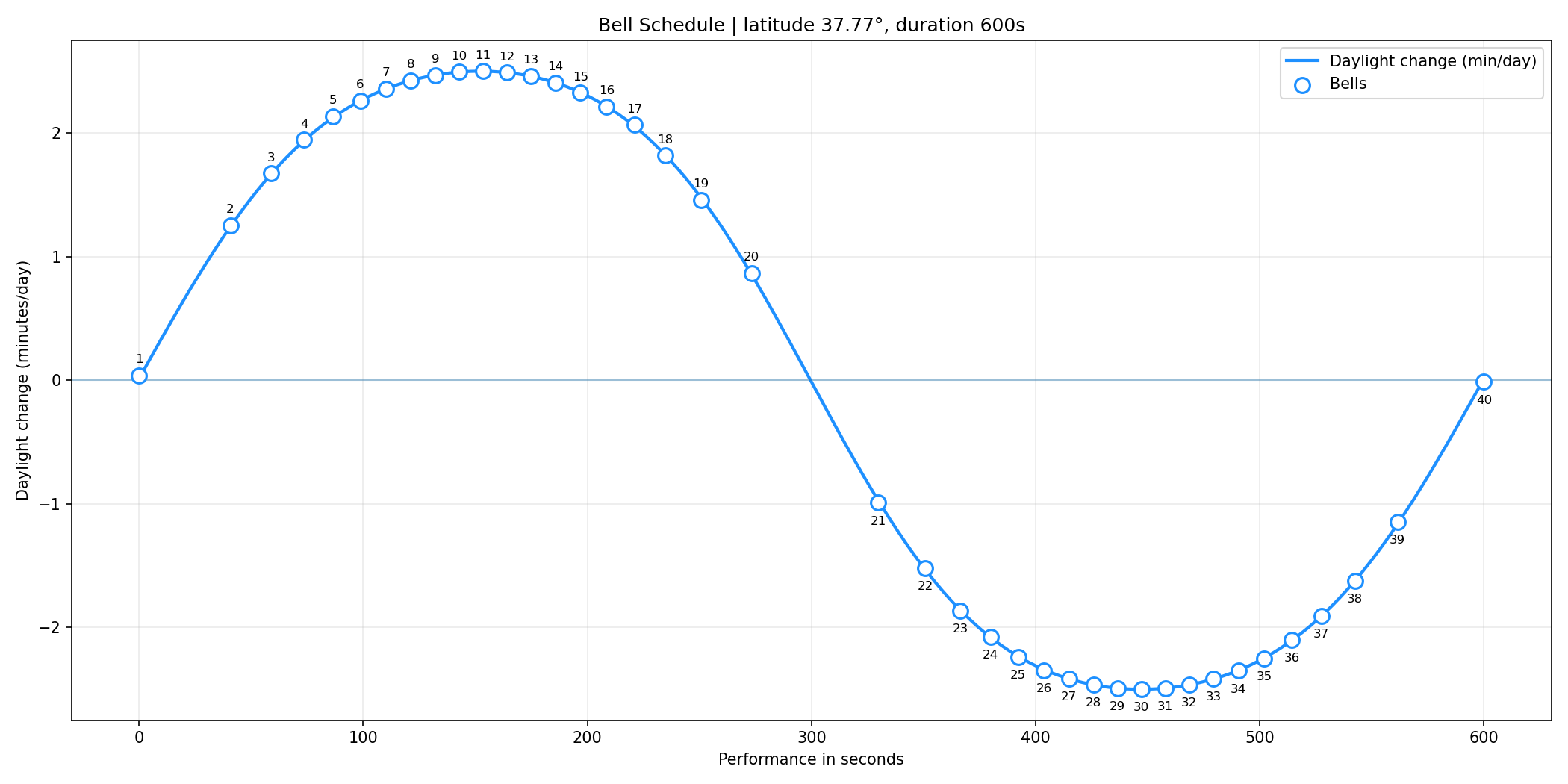
Data visualization of daily daylight change over the course of a year by Greg Niemeyer, UC Berkeley Art Practice
Participation as Performance
Building on earlier participatory works such as Polar Tide and To The Sun, Niemeyer and collaborators have long explored how audiences can become performers in large-scale bell and carillon works. With Solstice Bells, participation expands globally: everyone plays along.
Participants are encouraged to interpret the score freely, individually or in groups, from formal concert settings to spontaneous neighborhood gatherings.
Why It Matters
The winter solstice marks both an ending and a beginning. It is a moment to reflect on what has passed, what lies ahead, and how we might face the future together rather than alone.
As the year turns, Solstice Bells proposes proposes: What would it sound like if twe all listened for brighter days together?
Event
Solstice Bells
Winter Solstice, December 21, 2026 at 21:50 CET, 20:50 GMT, 15:50 EST, 12:50 PST.
Contact / Participation Info
Bell towers, institutions, community groups, schools, and individuals interested in participating are invited to join the global ringing. For more information, contact one of the artists mentioned above. Participating institutions include:
University of California, Berkeley
TBA